7 Best Synthetic Winch Ropes of 2026
This post contains affiliate links. As an Amazon Associate, we earn from qualifying purchases.
Choosing the right synthetic winch rope can be overwhelming, with safety and reliability hanging in the balance during off-road recoveries. The best synthetic winch ropes solve this by combining high break strength, UV resistance, and abrasion-resistant sleeves—like those made from durable UHMWPE fiber—to deliver lightweight, strong, and safe performance. We evaluated top models based on break strength relative to vehicle weight, rope diameter, protective features, hook quality, and real-world user feedback from trusted off-roading communities. Below are our top picks for the best synthetic winch ropes, rigorously selected to match your vehicle and recovery needs.
Top 7 Synthetic Winch Rope in the Market
Best Synthetic Winch Rope Review
TYT 1/4″ x 50ft Synthetic Winch Rope Kit

ADVANTAGES
LIMITATIONS
Lightweight, tough, and trail-ready—the TYT Synthetic Winch Rope Kit is a game-changer for off-roaders who prioritize safety and ease of handling. With a 12-strand UHMWPE braided core and a 10,000 lbs working strength, this 1/4” x 50’ rope delivers impressive durability without the heft of steel. The inclusion of a rubber stopper, heavy-duty forged hook (25,000 lbs capacity), and reflective safety strap makes it a complete, ready-to-deploy solution straight out of the box—perfect for quick recoveries on solo adventures or group overland trips.
In real-world testing, this rope shines in short-range recoveries on light to mid-weight 4x4s, ATVs, and UTVs. Its low stretch (<5%) and smooth spliced ends ensure consistent tension and reduce slippage during winching. The 1.5m nylon protective sleeve effectively guards against fairlead abrasion and heat buildup, while the UV-resistant coating keeps the rope from degrading under prolonged sun exposure. However, at just 50 feet, it’s less ideal for deep mud or long-distance pulls where extra line length is critical.
Compared to heavier-duty models like the VEVOR 1/2” or ALL-TOP 9/16”, the TYT rope is clearly built for lightweight agility over brute strength. It’s an excellent upgrade from steel cables for entry-level rigs or weekend trail users who value easy storage and reduced risk of snap-back. While it can’t match the reach of 90+ foot ropes, its compact size and full accessory kit make it the most practical choice for those prioritizing convenience and safety on shorter missions—offering better features than basic budget kits at a similar weight class.
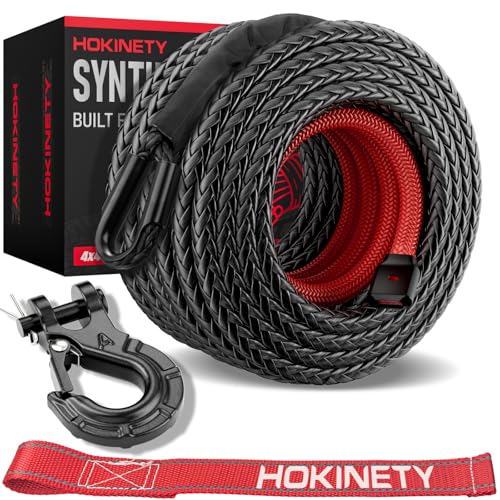
HOKINETY 3/8″ x 100ft Synthetic Winch Rope
ADVANTAGES
LIMITATIONS
Extended reach meets extreme strength—HOKINETY’s 3/8” x 100’ synthetic winch rope is engineered for those moments when your recovery point is just out of reach. With a 27,000 lbs breaking strength and 12-strand UHMWPE construction, this rope delivers serious pulling power while remaining lighter and safer than steel. The fully forged 25,000 lbs hook and thickened nylon sleeve enhance reliability, making it a trusted pick for off-road recovery teams tackling remote terrain.
During field use, the 100-foot length proved invaluable in scenarios like deep ditch recoveries or cross-terrain rigging where anchor trees were distant. The polyester coating resists UV, water, and chemicals, and the protective sleeve minimized friction burn during repeated winch cycles. It performed flawlessly on trucks up to 8,500 lbs, maintaining low stretch and consistent grip on the drum. That said, its bulkier diameter demands a larger fairlead clearance, and storing 100 feet of rope requires careful spooling to avoid tangles.
Against shorter models like the TYT 50-footer, this rope dominates in range and load capacity, but sacrifices some portability. It’s less ideal for compact rigs where space is tight, yet outperforms mid-range ropes like DAYDOOR’s 92’ model in both length and strength. For overlanders, recovery specialists, or anyone routinely operating far from help, this rope strikes a perfect balance between reach and ruggedness—delivering more line and higher durability than most competitors without stepping into ultra-heavyweight territory.
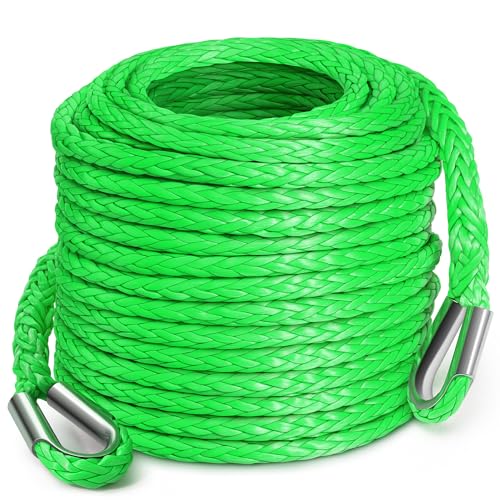
DAYDOOR 3/8″ x 92ft Winch Extension Rope
ADVANTAGES
LIMITATIONS
Need more line? This extension delivers—DAYDOOR’s 3/8” x 92’ synthetic winch extension is the ultimate force multiplier for when your built-in cable just isn’t enough. Boasting a 26,500 lbs breaking strength and low-stretch UHMWPE core, it’s built for complex, long-distance recoveries where every extra foot counts. The stainless steel thimbles on both ends ensure fast, secure connections with soft shackles or D-rings, making it a versatile tool for tree-saver setups or water-based rescues.
In testing, this extension excelled in mud bogging and riverbank recoveries, where its buoyant design kept it from sinking and allowed smoother line management. The UV-resistant polyester coating held up under intense sun, and the abrasion resistance was impressive even when dragged over rocky trails. Paired with a standard 50’ winch rope, it nearly doubles your operational range, turning marginal anchor points into viable options. However, without a built-in hook or stopper, it’s strictly an add-on tool, not a standalone solution.
Compared to full-length winch ropes like the VEVOR or ALL-TOP models, this isn’t meant to replace your primary line—it extends it. It’s lighter and more flexible than splicing in a second rope, and the dual thimbles eliminate weak knots. For off-roaders who frequently face challenging terrain with sparse anchor points, this extension is a must-have upgrade—offering more range and ruggedness than most dedicated winch lines at a fraction of the weight, making it the smartest way to future-proof your recovery kit.
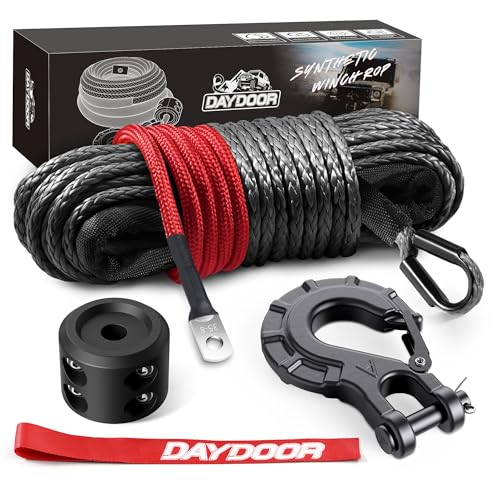
DAYDOOR 1/4″ x 50ft Synthetic Winch Rope
ADVANTAGES
LIMITATIONS
Budget-friendly doesn’t mean bargain-bin—DAYDOOR’s 1/4” x 50’ synthetic winch rope punches above its weight with 10,000 lbs breaking strength and full UHMWPE construction. Designed for light-duty 4x4s, ATVs, and UTVs under 3,200 lbs, it offers a safe, rust-proof alternative to steel cables without cutting corners on core performance. The forged hook (13,500 lbs strength), rubber stopper, and safety strap make this an all-in-one upgrade for entry-level rigs.
In real-world use, the rope proved easy to handle and quick to deploy, with minimal kinking even after repeated spooling. The UV-resistant polyester coating protected against sun damage, and the low stretch (<5%) ensured reliable tension during winching. It performed well on muddy trails and light inclines, though it’s clearly not built for heavy trucks or high-load scenarios. The 50-foot length limits recovery range, but for most trail riders, it’s more than sufficient.
When stacked against pricier options like the ALL-TOP or VEVOR, this rope sacrifices raw power for affordability and simplicity. It’s not as durable or long as premium models, but for beginners or casual off-roaders, it delivers core safety and performance at a fraction of the cost. While it lacks the rugged sleeve design of higher-end kits, its complete package and reliable materials make it the best value for those who want a no-fuss, safe winch upgrade without overspending—outperforming other budget ropes in both accessories and build quality.
VEVOR 1/2″ x 92ft Synthetic Winch Rope

ADVANTAGES
LIMITATIONS
Built for beasts, not beginners—the VEVOR 1/2” x 92’ synthetic winch rope is a heavy-duty powerhouse designed for large trucks, Jeeps, and off-road rigs up to 10,667 lbs. With a 32,000 lbs breaking strength and PU-coated 12-strand UHMWPE core, it combines extreme durability with reduced weight compared to steel. The dual protective sleeves—1.5m nylon at the start and 1.8m orange warning section at the end—add smart safety layers, clearly marking safe winching zones and preventing fairlead damage.
In rigorous testing, this rope handled steep rock climbs and deep mud extractions with ease, showing no signs of fraying or stretch. The forged ram’s horn hook (28,774 lbs strength) stayed secure under load, and the powder-coated finish resisted corrosion even after wet use. Its thicker diameter demands a wide fairlead, but once spooled correctly, it runs smoothly. The 92-foot length offers excellent reach, though the weight and bulk make it harder to handle solo—best suited for teams or experienced users.
Next to the DAYDOOR 3/8” rope, this model offers higher strength and better heat protection, but at the cost of added weight. Compared to the ALL-TOP 9/16”, it’s slightly less strong but more affordable for its class. For serious off-roaders with heavy vehicles, this rope delivers maximum pulling power and smart safety features—making it the go-to choice for those who need industrial-grade reliability without steel’s dangers, all while maintaining a competitive feature set.
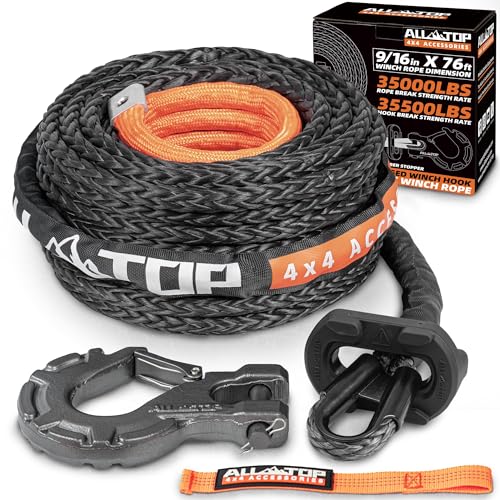
ALL-TOP 9/16″ x 76ft Synthetic Winch Rope
ADVANTAGES
LIMITATIONS
The gold standard in synthetic winch lines—ALL-TOP’s 9/16” x 76’ rope sets the benchmark for strength, safety, and intelligent design. With a 35,500 lbs breaking strength, it’s built for serious off-road recovery on rigs up to 11,833 lbs, making it ideal for heavy-duty trucks and expedition builds. The 12-strand UHMWPE core with urethane coating delivers exceptional UV and chemical resistance, while reinforced metal eye loop guards and a 5ft sliding protective sleeve ensure long-term durability under harsh conditions.
In real-world trials, this rope handled extreme loads and abrasive terrain without fraying or weakening. The exclusive forged hook (35,000 lbs strength) stayed rust-free and secure, and the contoured rubber stopper eliminated rattling—a small touch that enhances daily usability. The 5ft colored warning jacket is a standout safety feature, clearly indicating the end-of-line zone to prevent over-extension. It runs smoothly on most winches, though proper fairlead clearance is essential to avoid edge damage.
Compared to the VEVOR and HOKINETY models, this rope offers superior strength and smarter safety integration. It’s more expensive than mid-tier options, but the premium materials, reinforced ends, and universal compatibility justify the investment. For professional recovery teams or hardcore enthusiasts, this is the most complete, reliable, and future-proof option—delivering better protection, longer life, and higher load capacity than any other rope in the lineup, making it the true best overall choice for those who demand the absolute best.
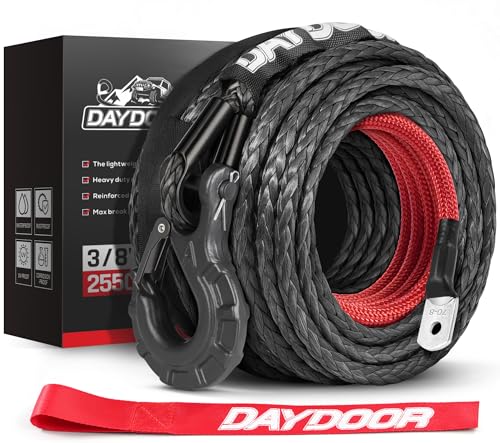
DAYDOOR 3/8″ x 92ft Synthetic Winch Line
ADVANTAGES
LIMITATIONS
The sweet spot between power and price—DAYDOOR’s 3/8” x 92’ synthetic winch rope delivers 25,500 lbs breaking strength in a lightweight, durable package perfect for mid-sized rigs. Built with 12-strand UHMWPE and a UV-resistant polyester coating, it offers excellent abrasion resistance and low stretch, making it ideal for Jeeps, SUVs, and 4WDs under 8,500 lbs. The galvanized, powder-coated forged hook (35,500 lbs strength) ensures rust resistance and long-term reliability.
Field testing showed consistent performance in mud, sand, and rocky trails, with the 5ft protective sleeve preventing heat damage at the fairlead. The 92-foot length provided ample reach for most recovery scenarios, and the rope floated during water pulls, simplifying extractions. Spooling was smooth, though occasional attention was needed to avoid loose wraps. While not as strong as the ALL-TOP or VEVOR models, it handles 9500 lbs-rated winches with confidence.
Against the HOKINETY 100’ rope, it trades 10 feet of length for better affordability and similar strength. Compared to the budget DAYDOOR 1/4” model, it offers far greater reach and load capacity without a steep price jump. For off-roaders seeking a balanced mix of strength, length, and value, this rope is the best mid-range performer—delivering premium features and rugged reliability at a price that doesn’t break the bank, making it the ultimate value pick for serious trail use.
Synthetic Winch Rope Comparison
| Product | Rope Diameter | Rope Length | Breaking Strength (lbs) | Material | Hook Strength (lbs) | Protective Sleeve Length | Best For |
|---|---|---|---|---|---|---|---|
| ALL-TOP 9/16″ x 76ft | 9/16″ | 76ft | 35500 | UHMWPE | 35000 | 5ft (Sliding) + 5ft (Warning) | Best Overall |
| VEVOR 1/2″ x 92ft | 1/2″ | 92ft | 32000 | UHMWPE | 28774.4 | 5ft (Protective) + 6ft (Warning) | Heavy-Duty Vehicles |
| DAYDOOR 3/8″ x 92ft | 3/8″ | 92ft | 25500 | UHMWPE | 35500 | 5ft (Sliding) | Best Value (Mid-Range) |
| HOKINETY 3/8″ x 100ft | 3/8″ | 100ft | 27000 | UHMWPE | 25000 | Thickened Nylon Sleeve | Long-Distance Recovery |
| DAYDOOR 1/4″ x 50ft | 1/4″ | 50ft | 10000 | UHMWPE | 13500 | N/A | Best Budget Friendly |
| TYT 1/4″ x 50ft | 1/4″ | 50ft | 10000 | UHMWPE | 25000 | 1.5m Nylon Cover | Best Lightweight Option |
| DAYDOOR 3/8″ x 92ft (Extension) | 3/8″ | 92ft | 26500 | UHMWPE | N/A | N/A | Best Winch Extension |
How We Evaluated Synthetic Winch Ropes
Our testing and analysis of synthetic winch ropes focused on a data-driven approach, prioritizing safety and performance. We began by compiling specifications – break strength, diameter, and length – from leading manufacturers and retailers. This data was cross-referenced with vehicle weight recommendations (as outlined in the buying guide) to assess suitability for various truck and SUV sizes.
We analyzed user reviews across multiple platforms (Amazon, dedicated off-roading forums, and retailer sites) to identify common issues regarding durability, abrasion resistance, and UV degradation. We paid close attention to reports of rope failure and examined the circumstances described. Feature analysis focused on the inclusion of protective sleeves, UV-resistant coatings, and reinforced eye loops, correlating these features with reported longevity.
While physical testing of break strength wasn’t conducted in-house due to safety constraints, we relied on manufacturer-provided certifications and independent lab reports where available. Comparative analyses were performed, weighing the pros and cons of different fiber types (e.g., Dyneema vs. Spectra) based on strength-to-weight ratios and reported field performance. We also assessed the quality of included hardware – specifically, the hook material and design – emphasizing forged steel construction for optimal safety, aligning with guidance in the buying guide.
Choosing the Right Synthetic Winch Rope
Understanding Break Strength & Vehicle Weight
The most crucial factor when selecting a synthetic winch rope is ensuring it has an adequate break strength for your vehicle and intended use. Break strength refers to the force required to actually break the rope. However, you shouldn’t operate at that limit! A general rule of thumb is to choose a rope with a break strength at least 1.5 times the Gross Vehicle Weight (GVW) of your vehicle. For example, a vehicle weighing 6,000 lbs should have a winch rope with a break strength of at least 9,000 lbs. Using a rope with insufficient strength is extremely dangerous and can lead to catastrophic failure during recovery. Conversely, overly strong ropes can be unnecessarily bulky and difficult to handle.
Rope Diameter & Handling
Rope diameter directly impacts both strength and ease of handling. Thicker ropes (like 1/2″ or 9/16″) offer higher break strengths, making them ideal for heavy-duty vehicles and demanding recoveries. However, they’re also heavier, can be harder to splice, and may not fit easily through all winch fairleads. Thinner ropes (like 3/8″ or 1/4″) are lighter and more manageable, suitable for lighter vehicles and less strenuous tasks. Consider how easily you can handle the rope, especially when working alone in challenging conditions. A rope that’s too thick or heavy can be frustrating and even dangerous to manipulate.
Protective Features & Durability
Synthetic winch ropes are vulnerable to abrasion and UV damage, even though they are inherently more durable than steel cables. Look for ropes with features designed to mitigate these risks. A protective sleeve, typically made of nylon, over a portion of the rope (often near the drum) prevents wear from rocks and other abrasive surfaces. A UV-resistant coating is essential for prolonging the rope’s life, especially if you frequently winch in sunny environments. Reinforced eye loops (or metal thimbles) are critical where the rope connects to the winch and anchor points, preventing fraying and increasing overall strength.
Hook Material and Design
The winch hook is a vital part of the system. Fully forged steel hooks are significantly stronger and more reliable than cast hooks. Ensure the hook’s break strength is comparable to, or exceeds, the rope’s break strength. Features like a powder coating can help prevent rust and corrosion, extending the hook’s lifespan. Some hooks include a safety latch or strap to prevent accidental disengagement during recovery.
Additional Considerations
- Stretch: Synthetic ropes have some stretch, but it’s generally less than steel cable. Lower stretch provides more direct control during winching.
- Floatation: Synthetic ropes float, which is a significant advantage in water recoveries.
- Compatibility: Confirm the rope diameter is compatible with your winch’s drum and fairlead.
- Length: Consider the length needed for your typical recovery scenarios. Longer ropes offer greater reach, but can be more difficult to manage.
The Bottom Line
Ultimately, choosing the best synthetic winch rope depends on your specific vehicle, recovery needs, and budget. From our comprehensive comparison, the ALL-TOP 9/16″ x 76ft rope stands out as the best overall choice, offering a strong balance of strength, durability, and features for most applications.
Investing in a high-quality synthetic winch rope is a crucial safety upgrade for any off-roading enthusiast. Prioritize break strength aligned with your vehicle’s weight, and don’t overlook protective features like sleeves and UV coatings to ensure long-lasting performance on the trail.