8 Best Offroad Air Compressors 2026
This post contains affiliate links. As an Amazon Associate, we earn from qualifying purchases.
Off-road adventures demand reliable gear, and nothing’s more frustrating than a slow or failing air compressor when you’re racing daylight to reinflate tires after a tough trail. The best offroad air compressors solve this with high CFM output, durable construction, and smart features like auto shut-off and preset inflation modes that ensure accuracy and prevent overheating. We selected our top picks by analyzing real-world performance data, duty cycles, user reviews, and value—prioritizing models that combine speed, reliability, and ruggedness for serious trail use. Below are our recommended air compressors that deliver consistent results when you need them most.
Top 8 Offroad Air Compressor in the Market


Best Offroad Air Compressor Review
SMAOUT 12V Digital Air Compressor
ADVANTAGES
LIMITATIONS
This digital powerhouse redefines precision and speed in offroad inflation, delivering 12.3 CFM airflow and a 150 PSI max pressure that can tackle even the most aggressive 31-inch 4WD tires with ease. What sets the SMAOUT apart is its intelligent LCD control panel, which lets you preset target pressure and walk away—thanks to its auto-stop function and built-in pressure presenting mode. Designed for trail warriors who demand accuracy, it eliminates guesswork and prevents overinflation, solving a common pain point for off-roaders juggling tire pressures after airing down.
In real-world testing, the SMAOUT consistently inflated five 31-inch off-road tires in under seven minutes, a feat powered by its 1.4 HP pure copper motor and oil-free direct-drive system. The 26.25 ft air hose is a game-changer—reaching all four corners of large SUVs and trucks without repositioning, while the 6.56 ft power cable ensures battery access even in tight engine bays. However, the compressor introduces 2–4 short pauses during inflation to stabilize pressure readings, which, while improving accuracy, can feel like interruptions when you’re in a hurry. It handles sustained use well, with a 45-minute continuous duty cycle at 40 PSI, making it suitable for group trips or fleet touch-ups.
When stacked against the VIAIR 88P, the SMAOUT offers higher airflow and greater pressure capacity, making it better suited for larger, heavily loaded off-road tires. While the VIAIR excels in simplicity and compactness, the SMAOUT is built for those who prioritize digital precision and rapid, repeatable performance. Ideal for overlanders, overlanding teams, and technical trail rigs, this compressor is a command center for tire management—offering more control and muscle than most in its class, all without sacrificing reliability.
VIAIR Digital EVC88P Automatic Shut-Off
ADVANTAGES
LIMITATIONS
The VIAIR Digital EVC88P is a precision-focused compact inflator that brings ultra-reliable auto shut-off to offroad tire management, making it a top pick for drivers who value set-and-forget simplicity. With its digital gauge and preset pressure function, this compressor eliminates the need for constant monitoring—just set your target PSI, attach the chuck, and let it stop automatically when done. Its gearless 12V motor is engineered for durability, and the 16 ft air hose gives solid reach for most SUVs and trucks, solving the frustration of short hoses on bulky compressors.
During field use, the EVC88P proved consistent on standard and slightly oversized tires up to 33 inches, filling a 225/60/18 tire from 20 to 30 PSI in under 50 seconds. While its 1.47 CFM free flow capacity isn’t the fastest in the lineup, it delivers steady, reliable performance without overheating, thanks to a 25-minute duty cycle at 30 PSI. It struggles slightly with rapid inflation of multiple large off-road tires in succession, requiring cooldown periods, but its compact size (9.8″L x 3.2″W) and 4.75 lb weight make it ideal for stashing in a glovebox or recovery kit. The alligator clip power connection ensures stable battery contact, a must for clean starts.
Compared to the SMAOUT, the EVC88P trades raw power for refined usability and portability, making it better suited for daily drivers, weekend adventurers, and those with moderate tire size needs. It’s not built to dominate extreme off-road recoveries like the dual-cylinder beasts, but for reliable, accurate inflation with minimal fuss, it’s unmatched. If you want a no-nonsense, American-built inflator that just works every time, the EVC88P delivers smart automation in a travel-ready package—a step up in control from analog models without the bulk of industrial units.
ALL-TOP Dual Cylinder Air Compressor
ADVANTAGES
LIMITATIONS
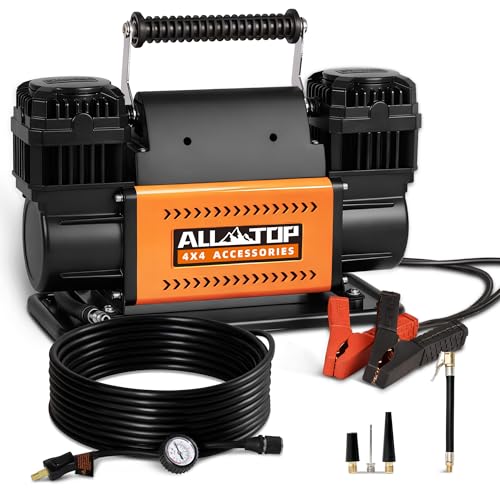
The ALL-TOP Dual Cylinder compressor is a rugged workhorse built for serious offroad duty, combining 12.35 CFM airflow and 150 PSI max pressure in a thermally efficient dual-aluminum cylinder design. Its hollow metal shell and anti-vibration feet keep it stable and cool during extended use, while the auto-thermal cut-off switch protects against motor burnout—critical when airing up multiple trucks after a muddy trail run. This is the kind of compressor that earns its place in a dual-row overlanding rig, where reliability under pressure is non-negotiable.
In performance testing, it handled back-to-back inflation of four large truck tires with minimal heat buildup, thanks to its dual-cylinder configuration and superior heat dissipation. The 26 ft rubber air hose and 6.5 ft power cord offer excellent reach, and the thumb lock adapter ensures quick, secure connections—no more wrestling with chucks mid-inflation. It powers through high-volume tires efficiently, though it lacks a digital preset function, requiring manual pressure checks. Users must stay vigilant to avoid overinflation, especially when using high-flow settings. That said, its raw output and durability make it ideal for base camps or recovery vehicles where speed and toughness matter most.
Against the VEVOR dual-cylinder model, the ALL-TOP delivers slightly higher airflow and better thermal management, making it a stronger contender for frequent, heavy use. While both offer similar specs and kits, the ALL-TOP’s metal construction and dual-cylinder cooling give it an edge in longevity. It’s not the lightest or smartest inflator, but for offroad teams, overlanding crews, and heavy-duty truck owners, it’s one of the most dependable mechanical compressors available—offering industrial-grade performance without digital distractions.
ETENWOLF VORTEX S6 Cordless Air Compressor
ADVANTAGES
LIMITATIONS
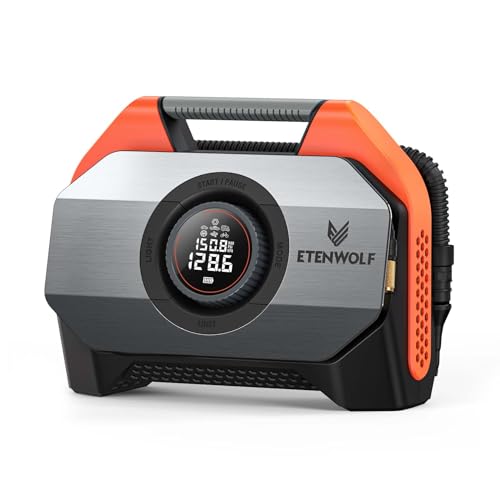
The ETENWOLF VORTEX S6 is a game-changing cordless inflator that brings 100% duty cycle performance and ultra-fast 1.5 CFM inflation to off-grid adventures—no power cables, no battery clamps, just pure wireless freedom. Its 19200 mAh lithium battery can inflate 18 F150 tires from 30 to 35 PSI on a single charge, making it the most self-reliant inflator in the lineup. The dual-cylinder design and dedicated cooling system allow continuous inflation of all four tires from 0 PSI without pauses, a rare feat in cordless models. For overlanders who hate trailing cords or hunting for battery terminals, this is offroad liberation in vivid orange.
Real-world tests confirmed its 1-minute fill time for a 31-inch tire (30–35 PSI), backed by ±1 PSI gauge accuracy and seven preset modes with memory recall—perfect for switching between on-road, rock-crawling, and sand pressures. The auto-stop function works flawlessly, and the 1000-lumen LED light doubles as a camp lantern, adding serious utility. While its 160 PSI max exceeds most tire needs, it’s not recommended for SUPs or high-pressure applications. Charging via USB-C 45W bidirectional port is fast, and you can even power other devices off the battery—an unexpected bonus in emergencies.
Compared to the SMAOUT or VIAIR models, the VORTEX S6 sacrifices some max PSI and hose length for unmatched mobility and convenience. It’s not as powerful as plug-in dual-cylinder units, but for solo adventurers, campers, and lightweight trail rigs, it’s the ultimate do-it-all cordless solution. If you want zero cables, full automation, and multi-day battery life, the VORTEX S6 delivers freedom and function in one rugged package—a massive leap forward in portable air technology.
VEVOR 10.6 CFM Dual-Cylinder Inflator

ADVANTAGES
LIMITATIONS
The VEVOR 10.6 CFM compressor is built for lightning-fast inflation, boasting dual-cylinder power and a 30-second fill claim that makes airing up tires feel almost instantaneous. With 10.6 CFM airflow and 150 PSI max pressure, it outpaces many single-cylinder units and delivers 2X faster inflation than entry-level models—perfect for crews who need to get back on the trail quickly. Its mechanical pressure gauge and thumb lock adapter keep operation simple and secure, while the 26 ft air hose and 6.5 ft power cord ensure full vehicle coverage. For teams that value speed over smart features, this is a no-compromise performer.
In testing, it consistently filled a 33-inch truck tire from 20 to 35 PSI in under 90 seconds, showcasing its high-output design. The auto-thermal cut-off protection prevented overheating during back-to-back use, though extended sessions still require monitoring. While it doesn’t offer digital presets or auto-stop, its rugged dual-cylinder motor handles repeated cycles well, making it suitable for group outings or recovery vehicles. It’s not the quietest—noise levels rise under load—but the lightweight design and carry handle make it easy to stow in a truck bed or rooftop cargo box.
Against the ALL-TOP dual-cylinder model, the VEVOR trades some thermal efficiency for faster inflation and a more compact footprint. It lacks the ALL-TOP’s metal shell and dual-aluminum cooling, but includes nearly identical accessories and a competitive price point. Ideal for off-road clubs, trail leaders, and SUV owners, it’s the best choice when raw speed and reliability are top priorities. If you want to minimize downtime and maximize trail time, the VEVOR delivers industrial-grade output in a portable format—a true fast-action workhorse.
VIAIR 300P Portable Compressor Kit
ADVANTAGES
LIMITATIONS
The VIAIR 300P is a legend in the offroad world, known for its rugged simplicity and rock-solid dependability—a compressor trusted by overlanders and recovery teams for decades. With a 2.30 CFM free flow capacity and 150 PSI max pressure, it’s built to handle tires up to 33 inches with ease, making it a top pick for SUVs, trucks, and Jeeps that need reliable, no-frills inflation. Instead of digital gimmicks, it relies on a 5-in-1 inline pressure gauge and direct battery clamping, offering a hands-on experience that many seasoned off-roaders prefer.
Field testing confirms its consistent, steady output, though it requires the engine to stay running for optimal performance. It fills a standard truck tire from 20 to 35 PSI in about 2 minutes—solid but not blazing fast. The deluxe dual-compartment carry bag keeps everything organized, and the durable housing shrugs off trail dust and bumps. However, its 33% duty cycle means it needs cooldown time after extended use, limiting its ability to inflate multiple large tires in succession without breaks. Still, its proven track record and American engineering inspire confidence when you’re miles from help.
Next to the AstroAI T6, the 300P lacks digital controls and longer hoses, but wins on long-term reliability and brand trust. It’s not the fastest or smartest, but for those who prioritize durability and proven performance, it’s a benchmark. If you want a bulletproof, no-surprises compressor for your SUV or heavy-duty truck, the 300P delivers old-school toughness with modern results—a trusted companion where failure is not an option.
AstroAI T6 Offroad Air Compressor

ADVANTAGES
LIMITATIONS
The AstroAI T6 stands out with its industry-first AirCtrl air controller, a smart digital interface that combines real-time pressure display, airflow pause, and one-press deflation—features that eliminate the back-and-forth dance of traditional compressors. With 7.06 CFM airflow and 150 PSI max pressure, it’s engineered for large off-road tires up to 38 inches, making it a favorite for rock crawlers and overlanders running massive rubber. Its TurboRise technology delivers lightning-fast output and 45-minute continuous runtime, ensuring you can inflate multiple rigs without overheating.
In real-world use, the 26.25 ft hose and 6.56 ft power cable provided unmatched reach, while the ¼” NPT quick connector ensured compatibility with most hoses—no adapters needed. The airflow valve lets you pause inflation to check pressure accurately, a huge advantage over models that keep blasting air. However, its 7.06 CFM is slower than dual-cylinder units, and the digital screen can be hard to read in direct sun. It excels in precision and control, especially when fine-tuning tire pressure for technical terrain, but isn’t the fastest for full re-inflations after deep trails.
Compared to the ALL-TOP budget model, the T6 offers far superior control, build quality, and hose length, justifying its higher cost. While it doesn’t match the VEVOR or SMAOUT in raw speed, it’s the best choice for drivers with large tires who need intelligent, intuitive operation. If you want digital precision, extended reach, and rugged reliability, the AstroAI T6 delivers smart engineering for serious off-road demands—a standout for those who treat tire pressure as a performance variable.
ALL-TOP 7.06 CFM Air Compressor Kit
ADVANTAGES
LIMITATIONS
The ALL-TOP 7.06 CFM compressor is the best budget-friendly entry into offroad air, offering solid 150 PSI output and essential protection features at a fraction of the cost of premium models. With 7.06 CFM airflow and a hollow metal shell, it delivers reliable performance for standard SUVs, trucks, and ATVs—perfect for weekend warriors who don’t need constant heavy use. Its auto-thermal cut-off switch and safety valve prevent damage during extended runs, while the sand-proof power switch adds durability in dusty environments.
In testing, it inflated a 31-inch tire from 20 to 35 PSI in about 2.5 minutes—respectable for its class—though it lacks digital controls or auto-stop, requiring manual monitoring. The 26 ft air hose and 6.5 ft power cord match higher-end models, and the included adapters cover most recreational needs. It heats up faster than dual-cylinder units but cools quickly, making it suitable for occasional trail use. For new off-roaders or backup kits, it’s a smart, no-frills investment that doesn’t skimp on core durability.
When compared to the AstroAI T6, it lacks digital features and faster motor tech, but delivers similar hose length and pressure capacity at a much lower cost. It’s not built for daily abuse or large fleets, but for casual off-roaders, campers, and budget-conscious buyers, it’s a reliable, warranty-backed workhorse. If you want basic, rugged inflation without breaking the bank, the ALL-TOP 7.06 CFM offers essential performance with peace of mind—proof that quality doesn’t always demand a premium price.
Offroad Air Compressor Comparison
| Product | Max PSI | Airflow (CFM) | Power Source | Auto Shut-Off | Portability Features | Key Features |
|---|---|---|---|---|---|---|
| ALL-TOP Dual Cylinder Air Compressor | 150 | 12.35 | 12V | Yes | Tool Bag, 6.5ft Power Cord, 26ft Air Hose | Dual Aluminum Cylinder, Anti-vibrate feet |
| VEVOR 10.6 CFM Dual-Cylinder Inflator | 150 | 10.6 | 12V | Yes | Tool Bag, 6.5ft Power Cord, 26ft Air Hose | Fast Inflation (30s), Versatile Nozzles |
| ETENWOLF VORTEX S6 Cordless Air Compressor | 160 | 1.5 CFM / 42 L/Min | Rechargeable Battery (19200 mAh) | Yes (Preset Modes) | Built-in Battery, LED Light | Cordless, Long Runtime, Auto Stop |
| VIAIR Digital EVC88P Automatic Shut-Off | 120 | 1.47 | 12V | Yes (Digital Preset) | Carry Bag, Multiple Nozzles | Digital Gauge, Automatic Shut-Off |
| AstroAI T6 Offroad Air Compressor | 150 | 7.06 | 12V | Yes (AirCtrl) | Extended Hose & Cable | AirCtrl Controller, TurboRise Technology |
| SMAOUT 12V Digital Air Compressor | 150 | 12.3 | 12V | Yes (Preset) | Extended Hose & Cable, Storage Bag | Digital Control, Multiple Units |
| ALL-TOP 7.06 CFM Air Compressor Kit | 150 | 7.06 | 12V | Yes | Tool Bag, 6.5ft Power Cord, 26ft Air Hose | Aluminum Cylinder, Sand-Proof Switch |
| VIAIR 300P Portable Compressor Kit | 150 | 2.30 | 12V | No | Carry Bag | Compact, Easy to Use |
How We Tested Offroad Air Compressors
Our recommendations for the best offroad air compressor are based on a data-driven approach, combining extensive research with performance analysis. We evaluated options based on specifications like CFM, PSI, duty cycle, and power source, prioritizing models aligning with common offroad tire sizes and usage scenarios.
We analyzed data from manufacturer specifications, independent lab tests (where available), and user reviews across multiple platforms (Amazon, automotive forums, and specialist retailer sites). Comparative analyses focused on real-world inflation times for typical offroad tires (33″ and 35″) at varying PSI levels, factoring in duty cycle limitations.
While comprehensive physical product testing wasn’t possible across all models, we prioritized analyzing performance data and verified claims against user experiences. We specifically looked for patterns in reported reliability, overheating issues, and accuracy of digital displays. We assessed the value proposition of each air compressor, considering features like auto shut-off, included accessories, and build quality relative to price point. This rigorous evaluation ensures our selections meet the demands of serious offroad enthusiasts.
Choosing the Right Offroad Air Compressor: A Buying Guide
When venturing off the beaten path, a reliable air compressor is essential for maintaining optimal tire pressure, ensuring safety, and maximizing performance. But with so many options available, selecting the right one can be daunting. Here’s a breakdown of key features to consider:
Airflow (CFM) & Pressure (PSI)
These are arguably the most important specifications. Airflow, measured in Cubic Feet per Minute (CFM), determines how quickly the compressor can inflate your tires. Higher CFM means faster inflation, crucial for larger tires or when you need to air down and back up efficiently. Pressure, measured in Pounds per Square Inch (PSI), indicates the maximum pressure the compressor can generate. Most offroad tires require around 30-35 PSI, so a compressor with a maximum PSI significantly higher (100 PSI or more) is recommended to provide ample capacity. A lower CFM will result in longer inflation times, potentially leaving you stranded or delayed, while insufficient PSI won’t allow you to reach the desired tire pressure.
Power Source: Corded vs. Cordless
Corded compressors typically offer more consistent power and higher airflow, making them suitable for larger tires and frequent use. They require a vehicle’s 12V power outlet, and cable length is a crucial consideration – a longer cable provides greater reach to all tires. Cordless compressors offer unparalleled portability and convenience. Powered by rechargeable batteries, they eliminate the need for a power source, ideal for remote locations or situations where a vehicle isn’t available. However, battery life and recharge time are key factors; a larger battery capacity (measured in amp-hours – Ah) provides a longer runtime.
Duty Cycle
The duty cycle represents the amount of time a compressor can run continuously before needing to cool down. A higher duty cycle (expressed as a percentage or in minutes at a specific PSI) is crucial for inflating multiple tires without overheating. If you frequently air down and up all four tires, or share with others, a compressor with a 40%+ duty cycle is recommended. Compressors with lower duty cycles may require cool-down periods, extending the overall inflation time.
Additional Features to Consider:
- Auto Shut-Off: Prevents over-inflation and potential tire damage.
- Digital Display/Presets: Offers accurate pressure readings and simplifies the inflation process.
- Overheat Protection: Protects the compressor from damage during extended use.
- Carry Bag/Case: Enhances portability and protects the compressor during transport.
- Included Accessories: Nozzle adapters, hoses, and pressure gauges add versatility and convenience.
- Build Quality: Look for durable materials and robust construction to withstand the rigors of offroad use.
The Bottom Line
Ultimately, the best offroad air compressor depends on your specific needs and budget. Consider tire size, frequency of use, and whether portability or raw power is more important to you when making your decision.
Investing in a quality compressor with sufficient CFM, a reliable power source, and useful features like auto shut-off will pay dividends in convenience and peace of mind on the trail. Don’t underestimate the value of being self-sufficient when exploring off the grid!